

Residency requirements, course age limits, and graduate transfer policy
On Tuesday, September 16, CollegeSource hosted another session of the Let’s Talk Transfer community discussion series, where all transfer professionals (regardless of whether they use CollegeSource products) are invited to share their expertise and ask questions on transfer-related topics. Over 242 staff from institutions of higher education joined the discussion live.

A breakout discussing evaluation process policies at the September 16, 2025, session of Let’s Talk Transfer.
Topic of discussion
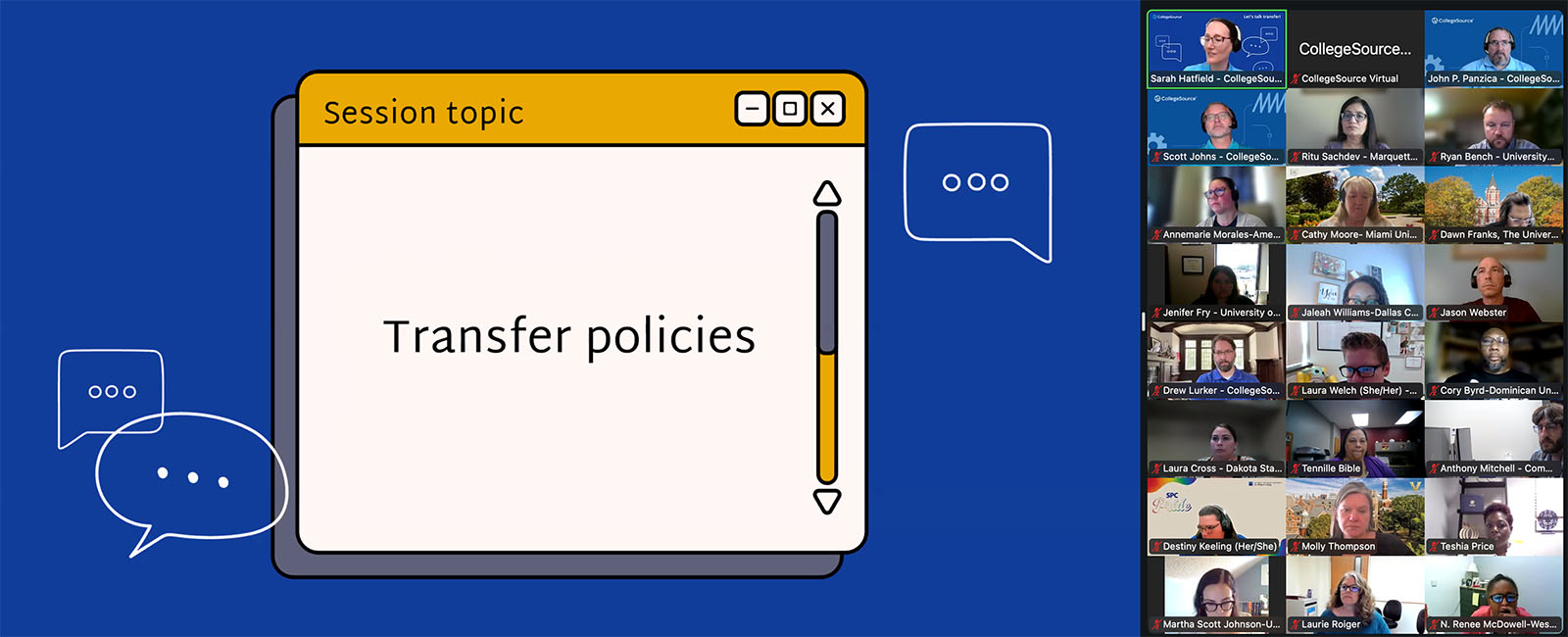
This month’s discussion centered around transfer policies. Representatives from community colleges, public and private universities, and state systems shared how they define residency, evaluate older coursework, and recognize prior learning.
Significant discussion centered around institution residency requirements. This policy defines the number or percentage of credits that students must complete at the institution to be eligible to receive a degree, certificate, or diploma. Institutions shared their policies, which generally require that students complete a percentage of the major or a specific number of credits at the college or university. There was also discussion about whether these policies included additional regulations around credit transfer after matriculation. While policies varied, it was clear that institutions were working to balance the goals of being transfer-friendly and protecting the integrity of the degree.
The conversation veered to age limits on transfer credit. Many institutions’ health care and technology programs have policies that transfer credits beyond a certain age (for example, 5 years) cannot meet degree requirements. This ensures students have the most up-to-date knowledge in the field to meet licensure requirements and keep up with ever-changing technology and practices. Sometimes, older courses may still be transferred as electives that apply towards the total degree credits. Most attendees noted no age restrictions around the transfer of general education courses since these courses are foundational, broadly focused, and not constantly evolving.
The most extensive discussion centered on graduate-level transfer credit policy. Multiple attendees shared their institution’s policies surrounding how many credits could be accepted into a Master’s or Doctoral program. Attendees also shared whether their institution reviews graduate-level coursework at the time of admission or on an ad hoc basis. The discussion proved to be a good reminder that while students may not transfer as frequently at the graduate level, it is equally important that resources and support be devoted to helping these students complete their educational journey.
The conversation broadened to include how institutions are incorporating Credit for Prior Learning (CPL) into their transfer policies. This continues to be an important topic as institutions are seeing more students looking to earn credit for scores on standardized exams, military courses and occupations, and work and life experience.
Breakout rooms
After 30 minutes of group discussion, attendees headed into the breakout rooms hosted by the CollegeSource Client Advisory Board and CollegeSource staff to discuss the following topics:
- Admission policies
- Dual enrollment policies
- Evaluation process policies
The session host, Sarah, stayed in the main room for general discussion. One attendee noted that their institution has a policy requiring 60 of the 120 credits of an undergraduate degree to be from a four-year institution and was curious to learn more about the policies of other institutions. Sarah shared some of the residency requirements mentioned in the chat. She noted the benefit of exploring how your institution’s policies compare to those of other institutions and how they impact students. Time was also spent reviewing questions and comments from the group discussion chat.
Watch the recording
Register now to access the September 2025 recording, including the transcript, chat log, and breakout session recordings.
Upon accessing the recording, please see the sidebar transcript for the link to view breakouts.
Join us again in November
The next Let’s Talk Transfer will take place on November 18. Scott Ziolko, Senior Evaluator at Columbia College of Missouri, will present on evaluating military credit recommendations.
If you previously registered for the series, the Zoom link provided can be used to access this session. If you haven’t registered yet, see the link below. Recordings will be available for those unable to attend. Please join us for the last session of the year!
0 Comments